How can the same set-top box behave like a PVR when a hard disk is attached, and like a simple zapper when no disk is available?
That is the practical problem I used when I first wrote about the Strategy Pattern, also called the Policy Pattern. The important detail is that the disk’s presence is known at runtime. I do not want to compile two entirely different versions of the playback logic just to handle a change in recording capability.
The solution is to separate the behaviour that changes from the product that uses it.
Archive note: Originally published on Tune2Wizard on 5 November 2014. The original article used the names ISTB, Irecords, pvr, zapper, recordable and nonRecordable, and showed a UML model created in Umbrello. The C++17 code below is a newly written, memory-safe teaching adaptation of that original example, not a verbatim copy of the archived implementation.
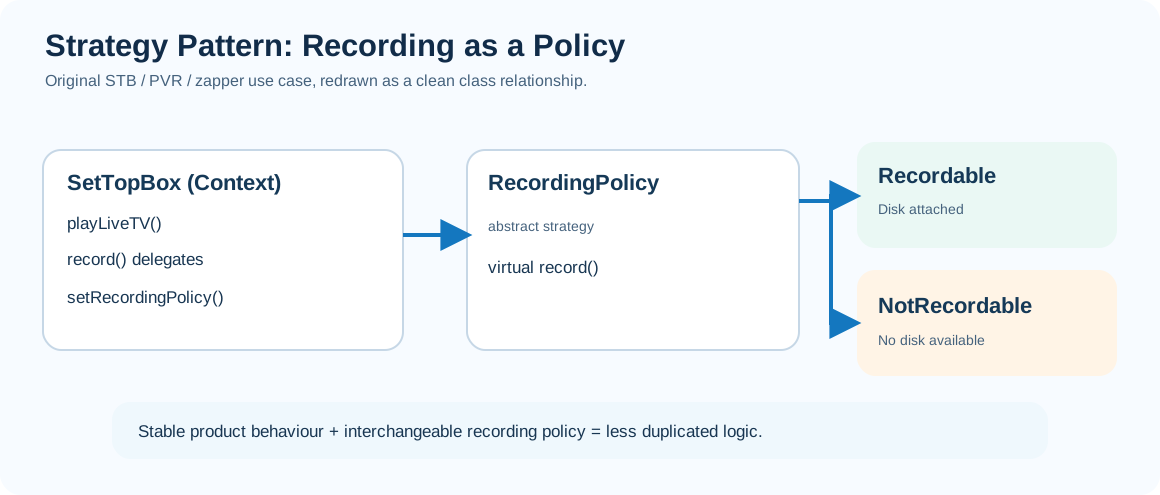
First, define the problem
Imagine a generic set-top box that can play audio/video and change channels in either mode.
- External hard disk present: Recording and playback of stored content can be enabled (PVR capability).
- External hard disk absent: Live viewing and channel changing still work, but recording is unavailable (zapper behaviour).
The low-level driver detects the disk when the device boots. The application can then select its recording policy. The key is that the hardware condition changes the policy, not the identity of the whole product.
The Strategy Pattern in one view
| Part | Responsibility in this example |
|---|---|
| Context | SetTopBox — exposes stable device operations and delegates recording behaviour |
| Strategy interface | RecordingPolicy — defines the recording operation |
| Concrete strategy | Recordable — recording is available |
| Concrete strategy | NotRecordable — recording is unavailable |
| Runtime decision | Hardware check or configuration selects the appropriate strategy |
My 2014 UML diagram represented a similar idea: ISTB had a relationship to an Irecords interface, with separate implementations of recording behaviour. The useful insight was composition — one object has a policy — rather than repeatedly copying the policy code into multiple device classes.
A modern C++ version of that experiment
Here is the same idea written with C++17 and std::unique_ptr. It avoids the raw-pointer ownership ambiguity in my original code.
#include <iostream>
#include <memory>
#include <utility>

class RecordingPolicy {
public:
    virtual ~RecordingPolicy() = default;
    virtual void record() const = 0;
};

class Recordable final : public RecordingPolicy {
public:
    void record() const override {
        std::cout << "Recording started\n";
    }
};

class NotRecordable final : public RecordingPolicy {
public:
    void record() const override {
        std::cout << "Recording unavailable: no disk attached\n";
    }
};

class SetTopBox {
    std::unique_ptr<RecordingPolicy> recordingPolicy;

public:
    explicit SetTopBox(std::unique_ptr<RecordingPolicy> policy)
        : recordingPolicy(std::move(policy)) {}

    void setRecordingPolicy(std::unique_ptr<RecordingPolicy> policy) {
        recordingPolicy = std::move(policy);
    }

    void playLiveTV() const {
        std::cout << "Playing live television\n";
    }

    void record() const {
        recordingPolicy->record();
    }
};

int main() {
    bool diskAttached = false; // Illustrative runtime hardware result
    SetTopBox box(std::make_unique<NotRecordable>());

    box.playLiveTV();
    box.record();

    diskAttached = true;       // Simulate connecting a hard disk
    if (diskAttached) {
        box.setRecordingPolicy(std::make_unique<Recordable>());
    }
    box.record();
}
Compile the independent teaching example with:
g++ -std=c++17 -Wall -Wextra -pedantic strategy-set-top-box.cpp -o strategy-set-top-box
./strategy-set-top-box
Expected output:
Playing live television
Recording unavailable: no disk attached
Recording started
The output is illustrative. This is a standalone teaching program; the original PDF’s implementation was based on Qt classes and used qDebug() for its messages.
Why composition helps
Without a policy interface, it is tempting to put every disk-detection if statement in the main set-top-box code or to create different products with duplicated playback and channel-changing logic. That can make new behaviours expensive to add.
With composition, I can introduce another policy — perhaps RecordingDisabledByParentalControl — without rewriting the main playback class. But this is not a rule that every simple if should become a design pattern. Strategy makes sense when the behaviour varies independently and is meaningful enough to encapsulate.
The original example used two concrete products, a PVR and a zapper. The revised version makes the runtime switch particularly clear by changing the strategy of one existing box. That is an intentional teaching improvement, not a claim about what the original code did at runtime.
A useful distinction: interface versus abstract class
In C++, an abstract class has at least one pure virtual function. It may also include data and implemented methods. What we informally call an interface is commonly an abstract base with pure virtual operations and a virtual destructor; C++ does not have a separate interface keyword in the language.
That matters because the policy type represents a contract. The set-top box depends on the contract, not on the concrete recording implementation.
The takeaway
In this experiment, the physical set-top box did not need to become a different object simply because its recording capability changed. What changed was the behaviour selected for that capability.
When something varies at runtime, isolate the varying policy and let the stable part of the system depend on an interface. That is the real value of Strategy.
Shreyas Joshi — originally published on Tune2Wizard, 5 November 2014. Source: personal archived PDF, StrategyPatternArticle.pdf. Original STB/PVR/zapper framing preserved; sample code intentionally modernised and distinguished from the original.