Source note: My personal Linux/MPLS notebook recorded Quagga-LDPD links, Linux MPLS forwarding,
tcpdumpand historical kernel experiments. This article reconstructs the mental model; all diagrams are newly drawn. It does not reproduce private training decks or employer network topology.
My question: OSPF already knows the route—why MPLS?
OSPF can compute the next hop to an IP destination, but a service-provider backbone may need service separation, label-switched forwarding and constrained paths. That is why I mentally separate three jobs:
- IGP (OSPF or IS-IS): reach the other routers and their loopbacks inside the provider network.
- Label distribution / tunnel setup: use mechanisms such as LDP or RSVP-TE, depending on design, to establish usable label forwarding entries or engineered LSPs.
- Data plane: forwards packets with labels by push, swap or pop actions. Labels are locally significant between neighbours, not permanent global destination identifiers.
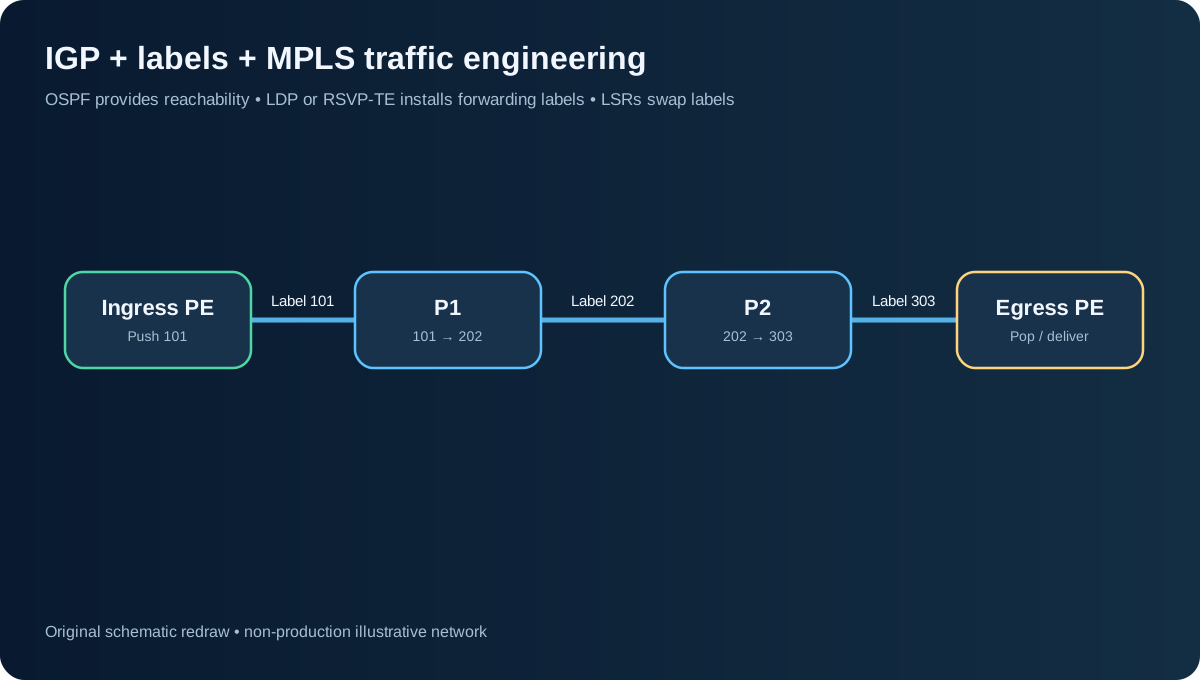
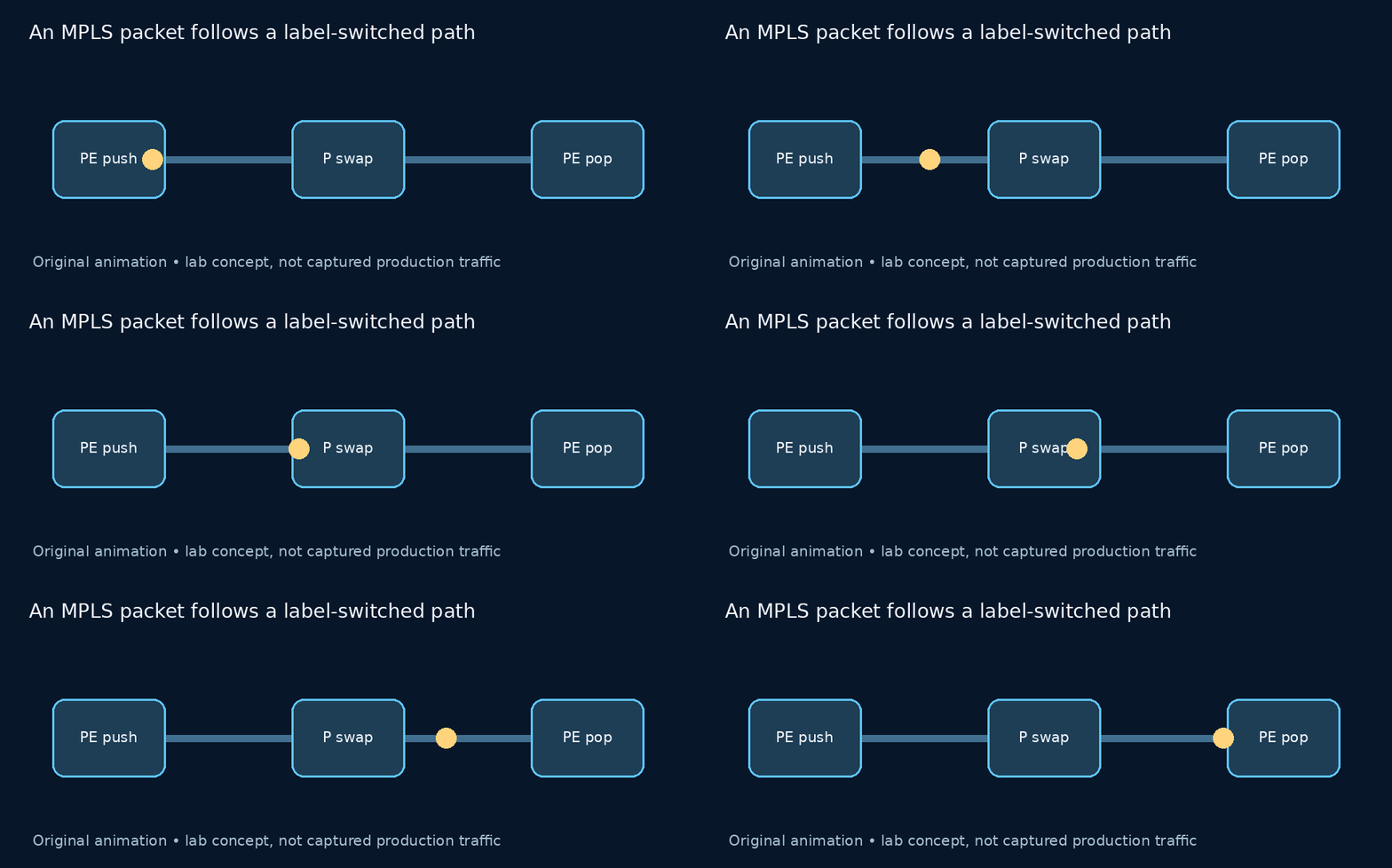
An ingress provider-edge router may push a label, intermediate label-switching routers swap transport labels, and the penultimate hop may perform penultimate-hop popping (PHP) where supported/appropriate. Real L3VPN and other services may use a stack of labels, not just one. One label may steer through the transport LSP; another can identify the VPN forwarding context.
A common misunderstanding
“OSPF creates the MPLS labels” is not quite right. OSPF advertises IP reachability (and, with TE extensions, additional link attributes). LDP or RSVP-TE typically distributes or signals labels in traditional MPLS designs; additional modern MPLS mechanisms exist. The IGP and label-control plane cooperate, but each has a distinct responsibility.
What is OSPF-TE?
OSPF Traffic Engineering extensions (RFC 3630) advertise attributes relevant to path calculation, such as TE metrics, available/reservable bandwidth and administrative groups where supported. OSPF-TE primarily adds information to the topology database. It does not by itself reserve bandwidth or create an RSVP-TE tunnel.
RSVP-TE (RFC 3209) can signal explicitly routed label-switched paths and request resource reservations. An ingress router or path-computation system can consider policy constraints such as bandwidth or link attributes. This can deliberately choose a path that is not the normal lowest-IGP-cost route.
| Topic | OSPF / OSPF-TE | MPLS / RSVP-TE |
|---|---|---|
| Primary job | Discover reachability; optionally publish TE attributes | Forward by label; optionally signal explicit/reserved paths |
| Control-plane data | Link-state database | Labels, LSP/tunnel state, reservation signalling |
| Normal objective | Shortest path under IGP cost | Service forwarding / constraints / path policy |
| Typical risk | Adjacency instability, flooding, cost mistakes | Label mismatch, tunnel failure, poor reservation or path choice |
Caution: bandwidth advertised for TE is not the same thing as real measured end-user throughput; TE does not guarantee an application’s SLA without the complete network design.
A historical Linux/MPLS notebook experiment
My old notes included this exact kind of capture:
sudo tcpdump -n -i eth2 'mpls and icmp'
The intention was to observe MPLS-encapsulated ICMP traffic, not merely ping a destination and assume labels were active. Historical notes also pointed to a Quagga LDP daemon and Linux MPLS forwarding support, including explicit-null label behaviour and Linux kernel/IPRoute2 compatibility questions.
A modern Linux/FRR lab can inspect the MPLS-related state using commands available in its installed build, for example:
# Linux routes/labels where MPLS support is enabled
ip -f mpls route show

# FRR interactive CLI: exact command support is version dependent
sudo vtysh -c 'show ip route'
sudo vtysh -c 'show mpls ldp neighbor'
Do not paste historical kernel-specific commands into a production host. MPLS kernel modules, sysctls, iproute2, FRR build features and distro versions determine which examples work.
A useful five-step lab in GNS3
- Draw PE1–P1–P2–PE2. Give routers point-to-point links and /32 loopbacks.
- Configure OSPF Area 0 across the core. Confirm all intended loopbacks are reachable before involving labels.
- Enable MPLS transport/LDP on supported virtual-router images. Confirm neighbour sessions and forwarding labels.
- Generate ping and traceroute traffic from one edge to the other; inspect the MPLS table and packet captures.
- Only then explore RSVP-TE and explicit paths on a platform/image that supports them. Compare the plain IGP path with the engineered LSP.
Verify, don’t assume:
show ip ospf neighbor
show ip route
show mpls forwarding-table
show mpls ldp neighbor
show mpls traffic-eng tunnels
These are Cisco-style verification examples; the available subset varies by IOS family, licence and feature set. An ordinary virtual IOS image may lack MPLS TE.
What I learnt
The simplest memory aid is map → labels → forwarding. OSPF makes the underlay reachable; label signalling establishes the forwarding context; MPLS moves packets across the backbone according to those labels. OSPF-TE enriches the map; RSVP-TE can use that information to build a deliberately constrained LSP.
Shreyas Joshi
CCNA certified — Routing and Switching
References: MPLS Architecture RFC 3031 · OSPF-TE RFC 3630 · RSVP-TE RFC 3209 · FRRouting