Historical lab reconstruction, prepared November 2026. My private Python
test_rstp.pyincludes tests for root election, loop prevention, link-break convergence and path-cost changes. Its employer-specific test code is not reproduced; the Python below is a fresh independent teaching example.
Why do we need Spanning Tree at all?
Redundancy is good until Ethernet frames keep circulating around a loop. A switch can flood unknown-unicast, broadcast and certain multicast traffic. With a Layer 2 loop and no effective loop prevention, frames can multiply and circle because ordinary Ethernet bridging has no IP-style TTL. The result is a broadcast storm, MAC-address flapping, congestion and potentially severe switch CPU/load issues.
The accurate statement is not “a router always crashes when there is a loop.” The immediate danger is a Layer 2 broadcast domain and its switches/bridges. A router connected to it may also be affected by excessive traffic, but it is not an inevitable router crash.
Electing a root bridge
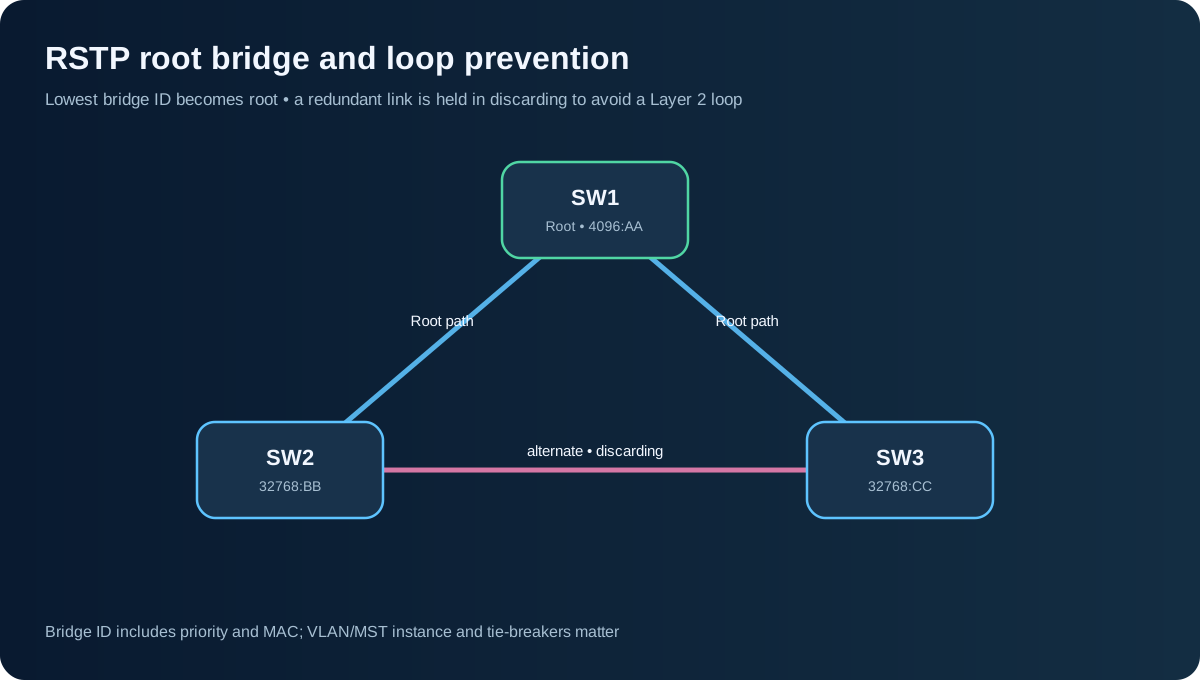
The Bridge ID contains a bridge priority component (with an extended system ID for VLAN/instance where applicable) and a MAC-address component. Bridges elect the lowest bridge ID. A switch then picks a best route towards the root using path cost and tie-breakers; this influences root, designated and alternate/discarding port roles.
Imagine three switches:
| Switch | Effective bridge priority | MAC (illustrative) | Expected result |
|---|---|---|---|
| SW1 | 4096 | 00:00:00:00:00:AA | Root |
| SW2 | 32768 | 00:00:00:00:00:BB | Non-root |
| SW3 | 32768 | 00:00:00:00:00:CC | Non-root |
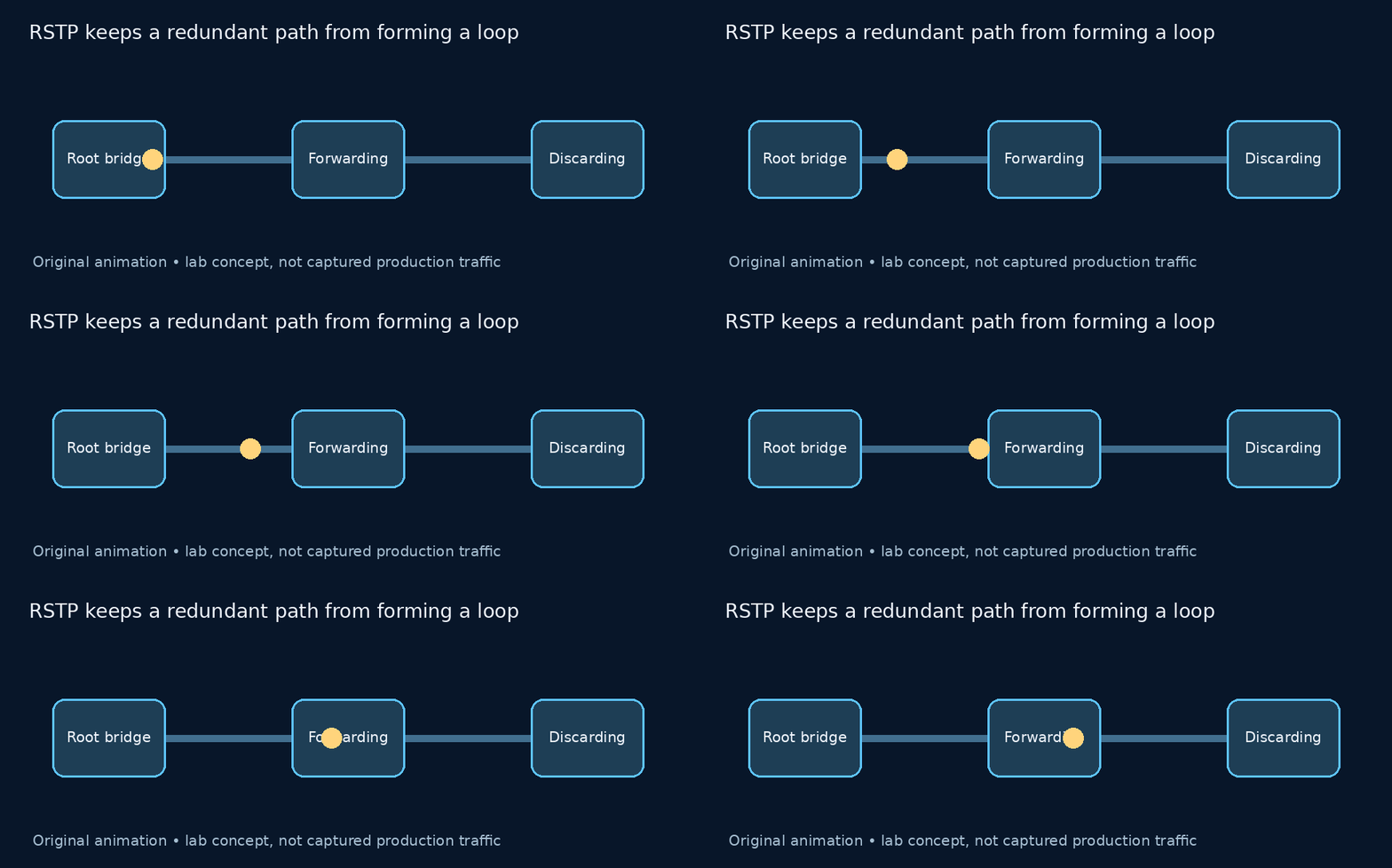
SW1 wins because its priority component is lower. If priority ties, the MAC portion helps decide. An alternate port blocks a redundant forwarding path, but RSTP can activate a suitable path after a change.
What my historical Python test checked
The original test_rstp.py described a sensible automated validation sequence: retrieve each node’s Bridge ID, check IDs are unique, sort to find the expected lowest Bridge ID, poll all devices until they agree on the root, and verify port roles. Separate tests generated traffic through a potentially looped topology, inspected interface counters, and examined convergence after breaking a link or changing path cost.
This is a stronger test than simply checking that STP is enabled. It validates election, convergence and actual traffic behaviour.
Here is new public-safe code showing the root-election expectation, without copying the device libraries:
# Standalone model: the expected winner, not a full STP implementation.
bridges = [
    ("SW1", 4096, "00:00:00:00:00:aa"),
    ("SW2", 32768, "00:00:00:00:00:bb"),
    ("SW3", 32768, "00:00:00:00:00:cc"),
]

# For a single agreed VLAN/instance, compare priority then MAC.
root = min(bridges, key=lambda b: (b[1], int(b[2].replace(':', ''), 16)))
print("Expected root:", root[0])  # SW1
The longer independent script public-labs/root_election_demo.py also checks simulated device reports. Real RSTP chooses port roles using more information than this small comparison.
My GNS3/Cisco validation commands
show spanning-tree
show spanning-tree vlan 10
show spanning-tree detail
show interfaces status
show mac address-table dynamic
On a Cisco lab switch supporting Rapid PVST+, this training configuration can deliberately bias a VLAN’s root choice:
configure terminal
spanning-tree mode rapid-pvst
spanning-tree vlan 10 priority 4096
end
show spanning-tree vlan 10
Not all GNS3 switch emulators implement hardware STP/RSTP features accurately. IOSvL2 or other licensed virtual switching images are usually preferable to GNS3’s most basic Ethernet switch node for this experiment.
Three experiments I would run
- Baseline: bring up all triangle links; capture the root bridge and forwarding/discarding roles. Check reachability.
- Link failure: disable one active link, time from physical change to stable forwarding and recovered traffic. Compare observed packet loss with expected behaviour.
- Path-cost change: adjust the relevant STP cost in the lab and observe whether the alternate choice changes while the root remains consistent.
Use tcpdump/Wireshark BPDU captures and traffic counters where possible. Avoid connecting an uncontrolled Ethernet loop to any real shared network.
The mental model I retain
The root bridge is not a master device that forwards every frame; it is the reference point used to build a loop-free logical tree. RSTP gives redundancy without leaving every redundant path forwarding at once. The point of automation is to prove that all devices agree, not just to read one configuration command.
Shreyas Joshi
CCNA certified — Routing and Switching
References: RSTP overview (IEEE 802.1D background) · Cisco spanning tree technology