QoS starts when a link is congested
If every packet arrives at the same time, who gets to go first? That is the real reason to talk about Quality of Service (QoS). QoS does not create extra bandwidth. It gives us tools to manage how competing traffic uses a constrained network.
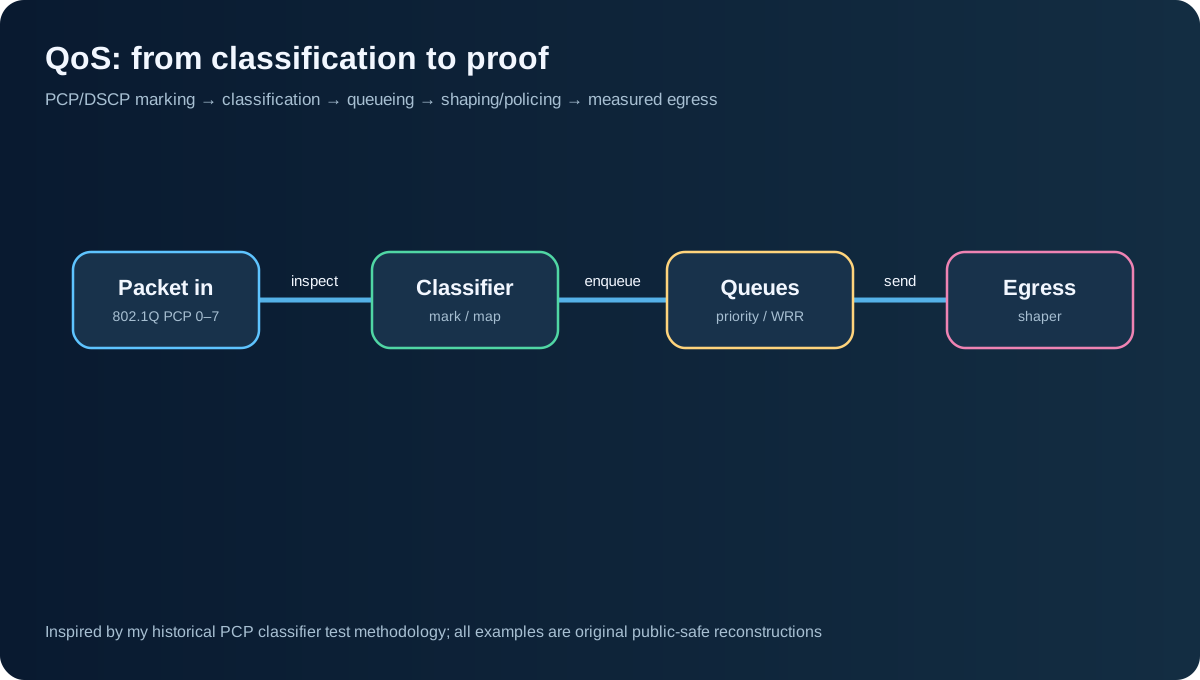
I separate the vocabulary into verbs:
- Classify: identify which traffic belongs to which class.
- Mark: assign or rewrite a priority indication (802.1Q PCP, IP DSCP).
- Queue/schedule: decide the order in which packets leave.
- Shape: buffer and pace egress to a target rate (introducing delay if necessary).
- Police: enforce a traffic rate, often dropping or re-marking excess packets.
- Measure: compare transmitted and received packets/bytes, delay, loss and class behaviour.
Layer 2 PCP is not the same as Layer 3 DSCP
802.1Q PCP (Priority Code Point) is a three-bit VLAN tag priority field with values 0–7. DSCP is a six-bit IP header field. Devices can map between them according to policy, but they are not automatically one-to-one or end-to-end trusted. Priority 7 is numerically highest but does not guarantee a real queue receives special treatment unless the device is configured accordingly.
A concrete test I recognised in my old work
The historical classifier test used a single device, two traffic-tester ports, VLAN-tagged frames, multiple PCP 0–7 traffic streams, and checks against transmitted/received byte counters. It exercised a straight priority map and then an inverted priority map. It also varied offered traffic rates under an output shaping policy and checked which streams were preserved. These details are from reviewing my own test file, not from a general networking tutorial.
That testing style asks better questions than “is QoS enabled?”
- Under low offered load, do all classes pass?
- When all classes compete, which streams lose throughput first?
- Does changing the PCP-to-queue mapping change observed results?
- Does measured packet loss match the configured policy and the tester’s counters?
New Python teaching model: priority scheduling
This short standalone simulation models three traffic classes competing for an 80 Mbps bottleneck. It is deliberately not an imitation of any proprietary device SDK.
# self-contained teaching model, not a hardware benchmark

def strict_priority(offers_mbps: dict[str, float], limit_mbps: float):
    """Allocate capacity from highest to lowest configured priority."""
    left = limit_mbps
    delivered = {}
    for traffic_class in ("voice", "video", "bulk"):
        delivered[traffic_class] = min(offers_mbps[traffic_class], left)
        left -= delivered[traffic_class]
    return delivered

requested = {"voice": 10, "video": 40, "bulk": 60}
actual = strict_priority(requested, limit_mbps=80)
print(actual)
# {'voice': 10, 'video': 40, 'bulk': 30}
assert sum(actual.values()) == 80
That gives us the idea of priority scheduling. It ignores bursts, packet sizes, token buckets, queue depths, weighted scheduling, preemption, microbursts and actual implementation behaviour. Real engineering needs traffic generation and measured counters, not just a Python model.
The full, newly written public exercise is in public-labs/qos_model.py in the downloadable package.
A small Cisco QoS inspection checklist
show interfaces
show interfaces counters errors
show policy-map interface
show class-map
show policy-map
Commands and supported configuration syntax depend on the image and platform. Some GNS3 IOS appliances do not support the same hardware QoS features as a physical switch or carrier Ethernet platform. Use the simulator for protocol reasoning and configuration concepts, then validate hardware QoS with real devices or capable test equipment.
What I would test next
For voice/video, the most useful outputs are not just “the packet went through.” They are loss, one-way delay where clocks are synchronised, jitter, packetization interval, queue depth and observed bitrate. A strict priority queue that starves all other traffic is not a successful enterprise design. Policing, bandwidth guarantees and correctly bounded queues matter.
My practical takeaway
QoS is the behaviour of a network under contention. My testing question became: I marked the packets; did the forwarding behaviour actually change when the network became busy? The difference between configuration and evidence is where test automation adds value.
Shreyas Joshi
CCNA certified — Routing and Switching
References: IEEE 802.1Q background · DiffServ architecture RFC 2475