From my engineering notebooks (2018–2019), reconstructed for publication in November 2026. The original themes appear in my FreeMind notes and networking experiments. The topology, configuration and terminal image below are new, educational reconstructions, not company diagrams, production data or captures of a real GNS3 session.
First, what problem are we solving?
When I started thinking about telecom networks, a simple question helped me: How does one router learn a network it is not directly connected to? And when that network belongs to a completely different service provider, who tells it which path to take?
I divide the answer into two layers:
- Inside one administrative network: use an Interior Gateway Protocol (IGP) such as OSPF or IS-IS to compute reachability and react to topology changes.
- Between autonomous systems: use Border Gateway Protocol (BGP) to exchange selected IP prefixes and apply routing policy. In practice, BGP can also run internally (iBGP) to distribute those external routes inside the AS.
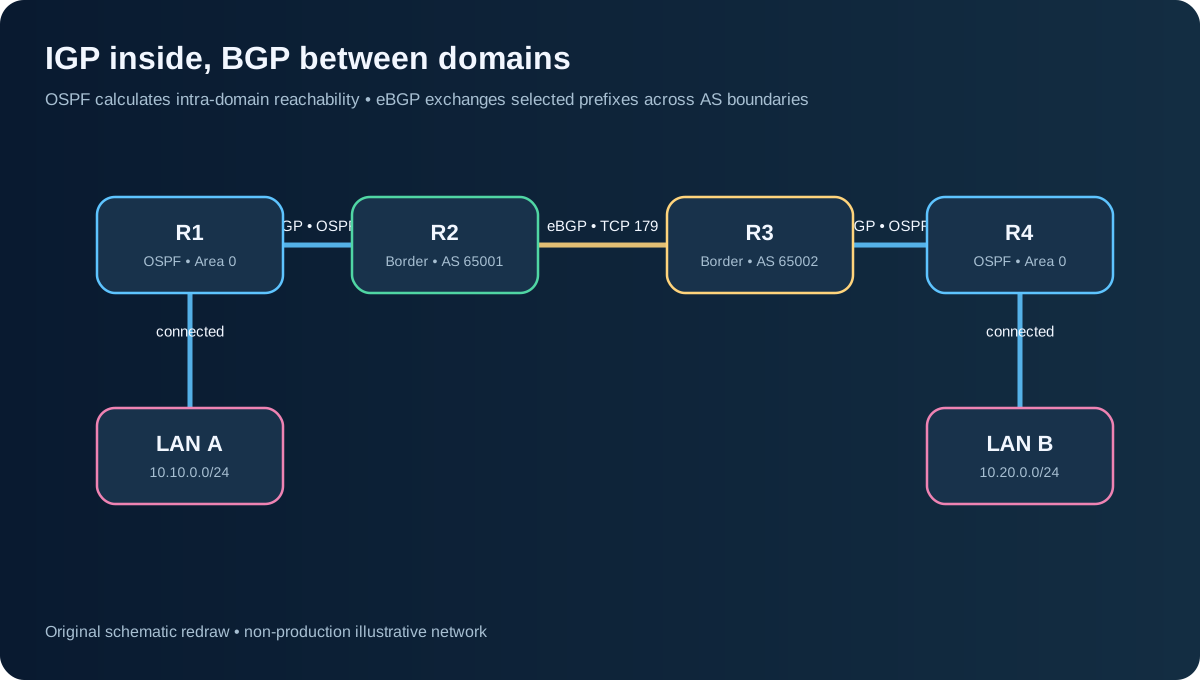
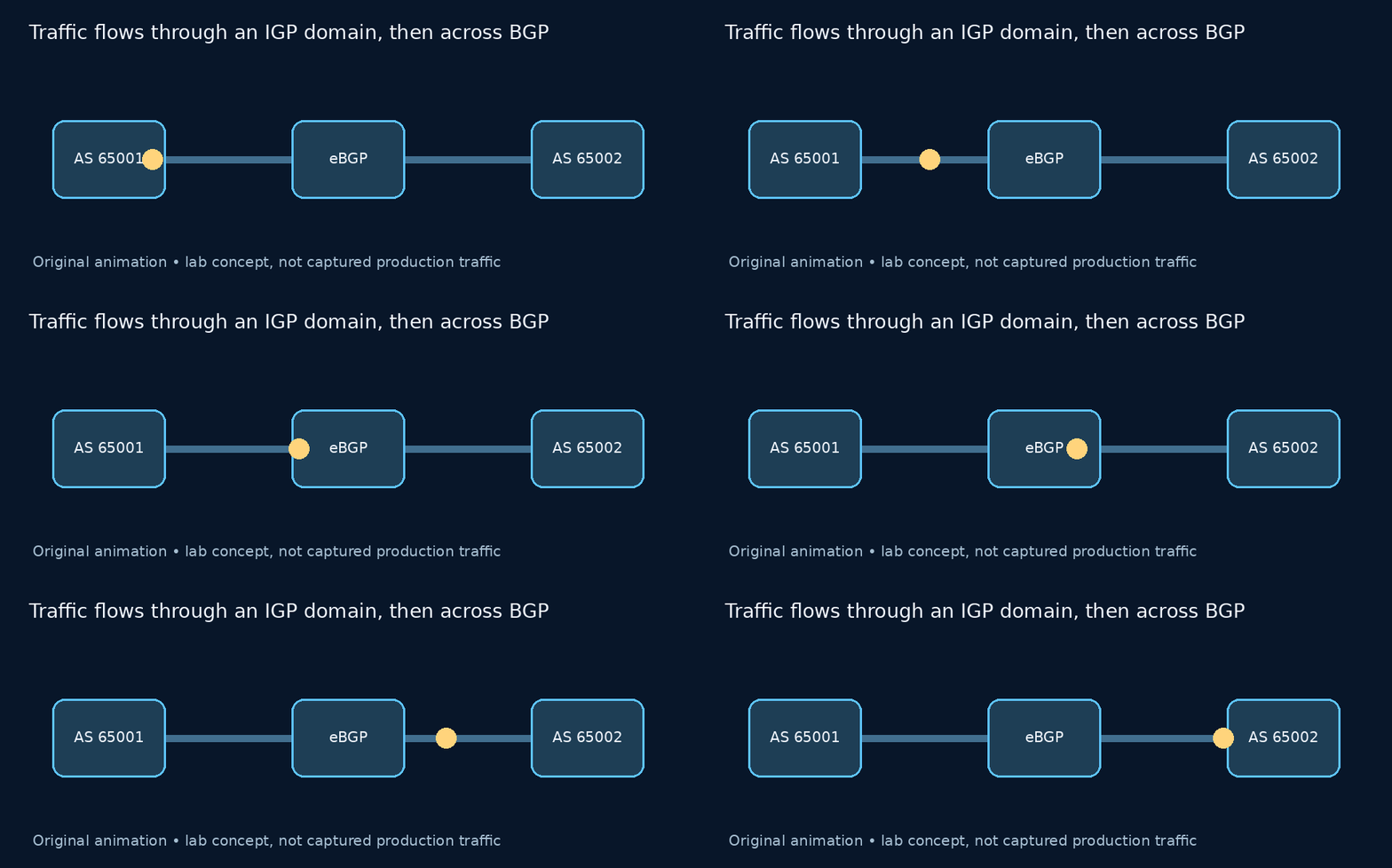
In my historical mind map, I wrote essentially: IGP — OSPF; EGP — BGP; telecom players have AS numbers; BGP runs between AS numbers. That was a useful starting map, but the real design is richer than just two acronyms.
OSPF: routers learning the internal map
OSPF stands for Open Shortest Path First. It is a link-state protocol. Routers exchange link-state information, maintain an area-specific link-state database and run shortest-path calculations. The cost of a link influences the selected path. The goal is not automatically “the least number of hops”; it is the least total OSPF cost.
A good mental model is that each router gets a consistent map of its area and independently calculates where to send packets. OSPF is a control-plane protocol; the router still forwards packets using its installed forwarding table.
Backbone, stub areas and NSSA
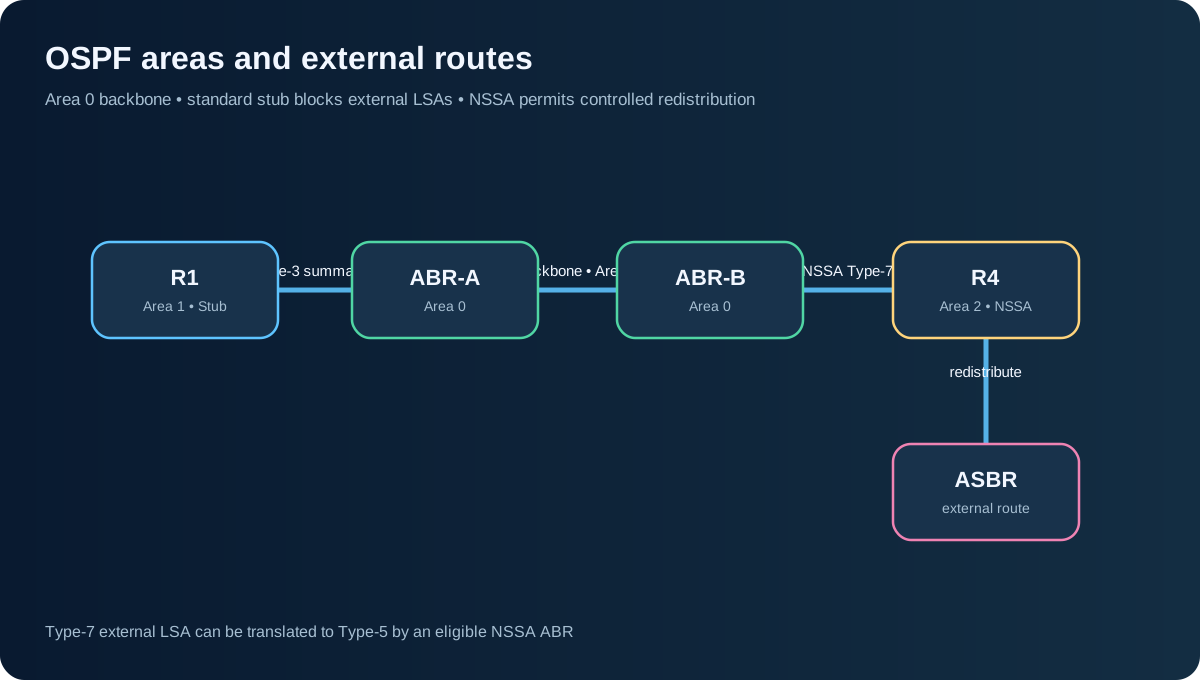
| Area | What I should remember | Practical reason |
|---|---|---|
| Area 0 | Backbone area connecting other OSPF areas via ABRs | Hierarchical routing design |
| Normal area | Allows the normal classes of LSAs, including external-route information | Flexible, but more LSA information |
| Stub area | Blocks Type-5 external LSAs; typically receives a default route | Reduce external route detail |
| Totally stubby area | Cisco extension that also suppresses most inter-area summaries | Very small routing table in a leaf area |
| NSSA | Not-So-Stubby Area permits an ASBR to inject external routes as Type-7 LSAs | Redistribution from a remote branch while retaining stub-like properties |
An NSSA ABR can translate eligible Type-7 LSAs to Type-5 LSAs for the wider OSPF domain. NSSA is not simply another name for a stub area. In a conventional stub area, redistributing a new external route inside that area is not allowed.
A commonly useful command family on Cisco IOS:
show ip ospf neighbor
show ip ospf interface brief
show ip ospf database
show ip ospf database external
show ip route ospf
show ip protocols
What am I looking for? Neighbour state, correct area membership, exchanged LSAs, installed OSPF routes and the next hop. FULL adjacency is normally the desired outcome on a point-to-point link; on broadcast networks, 2-WAY between two DROTHER routers can be normal.
A small GNS3 backbone lab
Use two routers with point-to-point link 10.0.12.0/30, and a LAN on R1. Exact interface names depend on the Cisco IOS image you are licensed to run in GNS3.
R1:
configure terminal
hostname R1
interface GigabitEthernet0/0
 ip address 10.0.12.1 255.255.255.252
 no shutdown
interface GigabitEthernet0/1
 ip address 10.10.0.1 255.255.255.0
 no shutdown
router ospf 10
 router-id 1.1.1.1
 network 10.0.12.0 0.0.0.3 area 0
 network 10.10.0.0 0.0.0.255 area 0
end
show ip ospf neighbor
show ip route ospf
R2:
configure terminal
hostname R2
interface GigabitEthernet0/0
 ip address 10.0.12.2 255.255.255.252
 no shutdown
router ospf 10
 router-id 2.2.2.2
 network 10.0.12.0 0.0.0.3 area 0
end
show ip ospf neighbor
show ip route ospf
The loop is straightforward: bring up interfaces, form an adjacency, examine the OSPF route on R2 to 10.10.0.0/24, then shut one link and observe the behaviour. If the test topology has only one path, traffic cannot magically continue—the point is to distinguish route withdrawal and reconvergence from real redundancy.
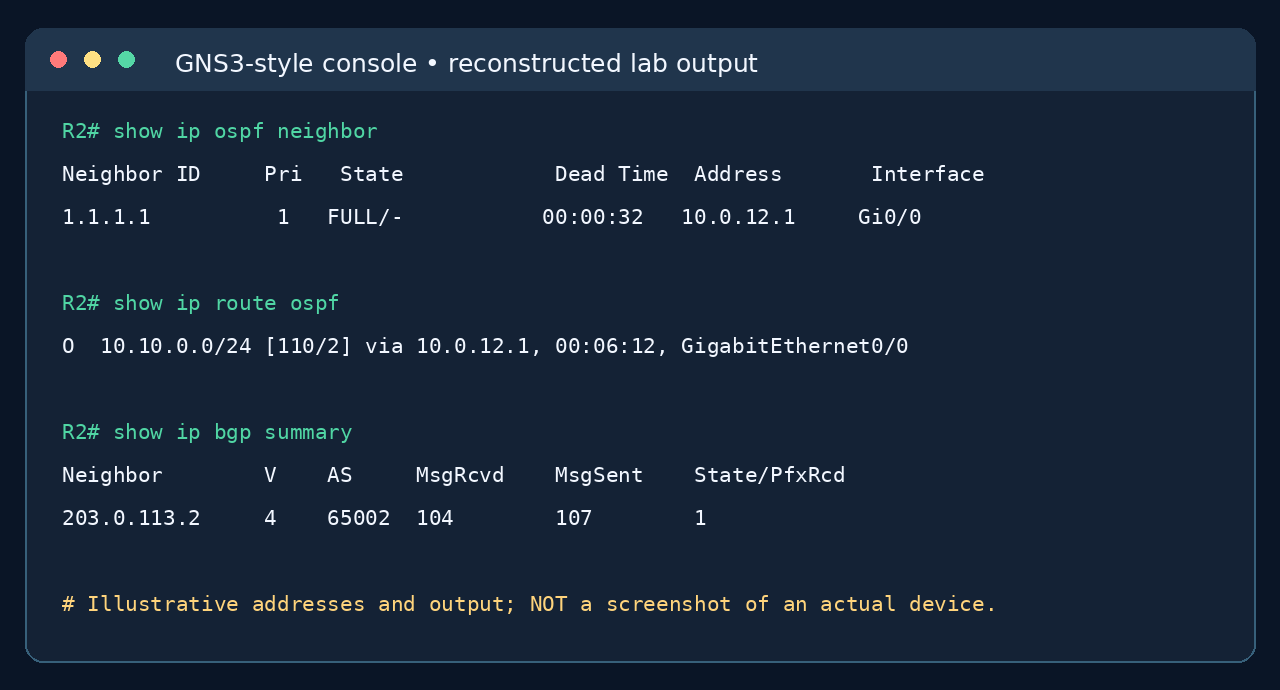
BGP: networks connect through autonomous systems
An Autonomous System (AS) is a routing-policy domain with an ASN (Autonomous System Number). In a simplified ISP diagram, Telstra, Optus and Aussie Broadband connect with other networks through BGP. BGP is a path-vector protocol: it exchanges reachable prefixes and path attributes such as AS_PATH, NEXT_HOP and LOCAL_PREF. It does not perform OSPF’s topology flooding across the Internet.
- eBGP exchanges routes between different ASNs.
- iBGP exchanges BGP routes within the same AS.
- OSPF can provide internal loopback/next-hop reachability needed by BGP without itself carrying the entire Internet routing table.
How do I find a provider’s ASN?
Look up an organisation or a public IP prefix in an RIR registry such as APNIC or an observed-routing service such as bgp.tools, Hurricane Electric BGP Toolkit or RIPEstat. Then check which ASN originates the actual prefix, not only who sells the mobile plan.
| Example | Useful public ASN to investigate | Qualification |
|---|---|---|
| Telstra | AS1221 | Telstra operates multiple ASNs; this is a prominent example |
| Optus | AS7474; also investigate AS4804 | Different Optus network segments can have different ASNs |
| Aussie Broadband | AS4764 | Commonly associated with the ABB network |
| Woolworths / Everyday Mobile | Not simply one mobile-provider ASN | Everyday Mobile uses the Telstra Wholesale Mobile Network; Woolworths Group’s separate AS153814 does not identify all mobile subscribers’ internet paths |
ASN ownership and prefix advertisements can change; check current routing data before making a claim about a specific IP address. A brand, an MNO, a reseller and an Internet transit AS are not interchangeable concepts.
Two practical lookups:
whois -h whois.apnic.net AS1221
whois -h whois.apnic.net AS7474
For a specific address, a public BGP lookup is more informative than assuming every IP address used by an ISP originates from one AS.
Small eBGP example: two private ASNs
These are lab-only private ASNs (65001 and 65002) and documentation addresses. Assume Router R2 has a route to 10.10.0.0/24 in its routing table, while R3 has a route to 10.20.0.0/24.
R2 — AS 65001:
interface GigabitEthernet0/1
 ip address 203.0.113.1 255.255.255.252
 no shutdown
router bgp 65001
 bgp router-id 2.2.2.2
 neighbor 203.0.113.2 remote-as 65002
 neighbor 203.0.113.2 description LAB-AS65002
 network 10.10.0.0 mask 255.255.255.0
R3 — AS 65002:
interface GigabitEthernet0/1
 ip address 203.0.113.2 255.255.255.252
 no shutdown
router bgp 65002
 bgp router-id 3.3.3.3
 neighbor 203.0.113.1 remote-as 65001
 neighbor 203.0.113.1 description LAB-AS65001
 network 10.20.0.0 mask 255.255.255.0
The BGP network command advertises an exact matching route already present in the local RIB; it does not create a route to that prefix. Also configure the internal paths and return routes appropriately for end-to-end reachability.
Verify:
show ip bgp summary
show ip bgp
show ip route bgp
show ip bgp neighbors
Can OSPF routes be redistributed into BGP—and back again?
Yes, with explicit design and filtering. For example, a BGP router may advertise selected OSPF-learned customer prefixes with network statements or redistribute ospf governed by route maps/prefix lists. But do not redistribute everything both ways: route feedback, accidental transit, excessive routing state and security exposure are real risks. A default route into an internal area is often a simpler design than injecting a full external table.
! Illustrative boundary policy: permit only one internal prefix
ip prefix-list EXPORT-LAN seq 5 permit 10.10.0.0/24
route-map OSPF-TO-BGP permit 10
 match ip address prefix-list EXPORT-LAN
router bgp 65001
 redistribute ospf 10 route-map OSPF-TO-BGP
This is an example of policy structure, not a configuration to apply to an Internet-facing device without route-leak safeguards and verification.
BGP neighbour TCP-MD5 authentication
One historical engineering note of mine says: BGP peer authentication — MD5 sum — socket option — kernel — double pointer versus pointer. I remember it as a reminder that a routing failure can cross layers: BGP configuration, TCP socket behaviour, C pointer handling and kernel APIs. It does not by itself prove the exact code fix or author.
In a compatible Cisco training lab, a neighbour password can configure TCP-MD5 authentication:
router bgp 65001
 neighbor 203.0.113.2 password lab-shared-secret
Configure a matching password on the peer. Use protected secret handling in real deployments. TCP-MD5 is a legacy mechanism with limitations; evaluate TCP-AO and platform-supported protections where appropriate.
The mental model I keep
OSPF tells routers how to reach things within their own domain. BGP tells different routing-policy domains which prefixes they are willing to exchange. A healthy provider network needs both fast and correct internal convergence and carefully controlled external reachability. Fast does not mean uncontrolled, and an AS path is not the same as a measured latency path.
Shreyas Joshi
CCNA certified — Routing and Switching
Technical references: OSPF NSSA RFC 3101 · BGP RFC 4271 · Telstra AS1221 · Optus AS7474 · Aussie Broadband AS4764 · Everyday Mobile coverage